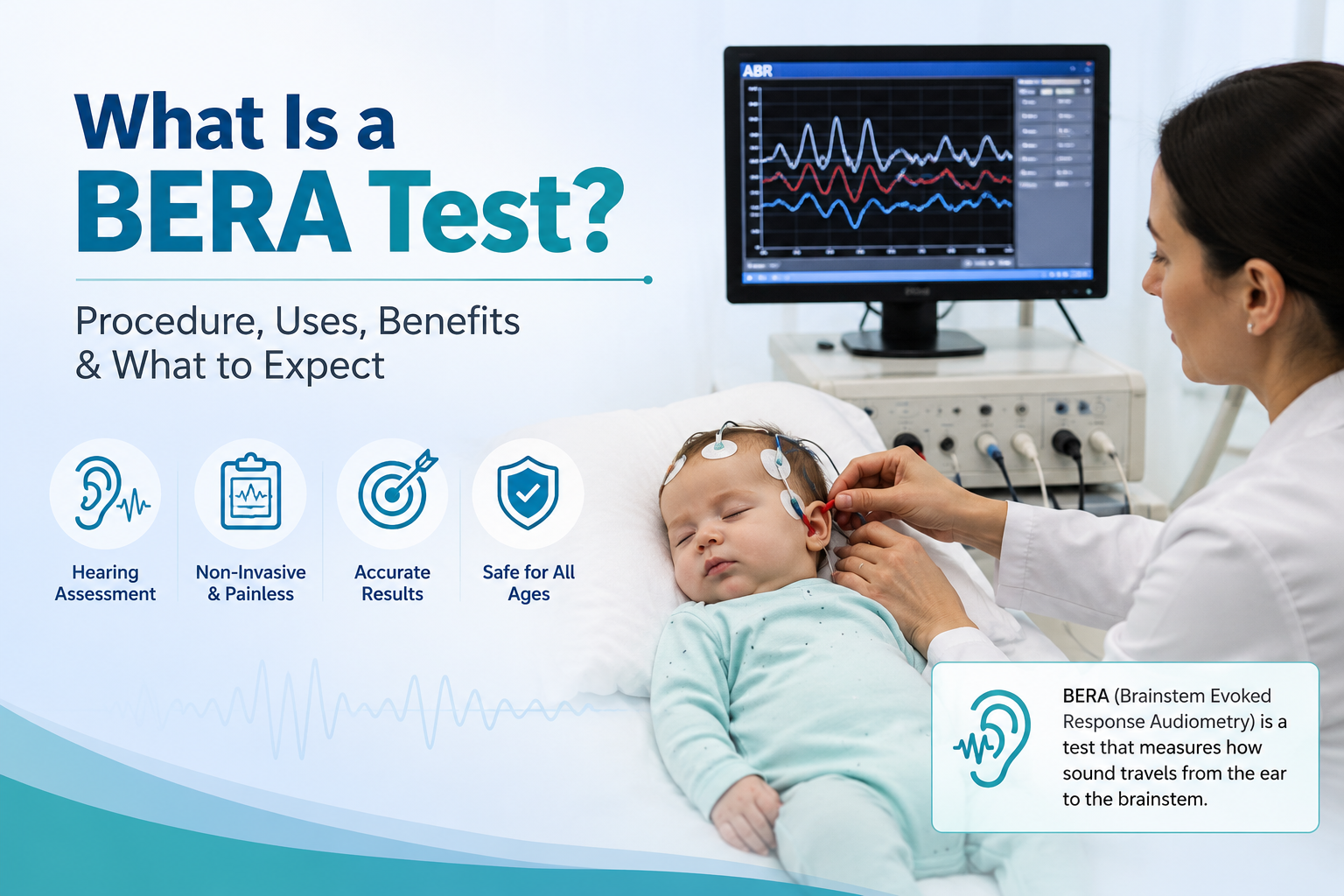
Hearing plays a crucial role in speech, language development, communication, and overall quality of life. While many hearing problems can be detected using standard hearing tests, some conditions require more advanced diagnostic evaluations. One such test is the BERA test, also known as the Brainstem Evoked Response Audiometry (BERA) or Auditory Brainstem Response (ABR) test.
Unlike conventional hearing tests that require active responses from the patient, a BERA test objectively measures how the auditory nerve and brainstem respond to sound. It is especially useful for evaluating hearing in newborns, infants, young children, and individuals who cannot participate in routine hearing assessments.
In this guide, you’ll learn what a BERA test is, why it’s performed, how the procedure works, who needs it, and what the results mean.
What Is a BERA Test?
A BERA (Brainstem Evoked Response Audiometry) test is an advanced hearing assessment that records the electrical activity generated by the auditory nerve and brainstem in response to sound stimuli.
Because it measures nerve responses rather than relying on verbal feedback, it is considered an objective hearing test and is highly accurate for diagnosing hearing disorders.
A BERA test is commonly used to:
- Assess hearing in newborns and infants
- Detect hearing loss in children and adults
- Evaluate auditory nerve function
- Diagnose certain neurological conditions affecting hearing
- Confirm hearing loss when routine hearing tests are inconclusive
Why Is a BERA Test Done?
Doctors and audiologists recommend a BERA test when a detailed evaluation of the hearing pathway is required.
Common reasons include:
- Delayed speech and language development
- Suspected hearing loss in infants
- Newborn hearing screening follow-up
- Difficulty responding to sounds
- Suspected auditory nerve disorders
- Unexplained hearing loss
- Tinnitus or certain neurological conditions
If you notice signs such as difficulty hearing conversations, delayed speech development, or concerns about your child’s hearing, scheduling a professional hearing test in Bangalore is the first step. An experienced audiologist in Bangalore can determine whether a BERA test or another hearing assessment is the most appropriate option based on your symptoms.
.Who Needs a BERA Test?
A BERA hearing test may be recommended for:
Newborns and Infants
- Babies who fail newborn hearing screening
- Premature infants
- Babies with a family history of hearing loss
- Infants with developmental concerns
Children
- Delayed speech and language development
- Difficulty responding to sounds
- Suspected hearing impairment
- Autism spectrum disorders requiring objective hearing assessment
Adults
- Sudden hearing loss
- Unexplained hearing difficulties
- Suspected auditory nerve disorders
- Persistent tinnitus
- Neurological conditions affecting hearing
How Is a BERA Test Performed?
The BERA procedure is painless and non-invasive.
Step 1: Preparation
Small electrodes are placed on the scalp and behind the ears after cleaning the skin.
Step 2: Headphones Are Placed
Soft earphones deliver clicking sounds or tone bursts into each ear separately.
Step 3: Recording Brain Responses
The electrodes record electrical signals generated by the auditory nerve and brainstem.
A computer analyzes these responses to determine how sound travels through the hearing pathway.
The test usually takes 30 to 90 minutes, depending on the patient’s age and cooperation.
Is a BERA Test Painful?
No.
The BERA hearing test is completely painless.
The electrodes only record electrical activity—they do not deliver electricity into the body.
Many infants sleep comfortably throughout the procedure.
Is Sedation Required?
Most adults and cooperative children do not require sedation.
However, sedation may sometimes be recommended for:
- Very young children
- Infants who cannot sleep naturally
- Individuals unable to remain still during the test
Your audiologist will explain whether sedation is necessary before the appointment.
What Conditions Can a BERA Test Diagnose?
A BERA test helps diagnose various hearing and neurological conditions, including:
- Sensorineural hearing loss
- Congenital hearing loss
- Auditory neuropathy spectrum disorder (ANSD)
- Auditory nerve abnormalities
- Brainstem disorders
- Retrocochlear pathologies
Because it evaluates nerve function rather than behavioral responses, it provides valuable diagnostic information when other tests are inconclusive.
BERA Test vs Audiometry
Many patients wonder whether they need a BERA test or a routine hearing test.
| BERA Test | Pure Tone Audiometry |
| Objective hearing assessment | Behavioral hearing assessment |
| No patient response required | Patient actively responds to sounds |
| Suitable for infants | Suitable for older children and adults |
| Measures auditory nerve function | Measures hearing sensitivity |
If you’re unfamiliar with routine hearing evaluations, explore the different types of hearing tests to understand how audiologists assess hearing using different diagnostic methods.
BERA Test vs OAE Test
Both BERA and OAE (Otoacoustic Emissions) tests are commonly used in hearing assessment.
OAE Test
- Evaluates inner ear (cochlear) function
- Frequently used for newborn hearing screening
- Quick screening tool
BERA Test
- Evaluates the auditory nerve and brainstem
- Confirms hearing loss
- Detects neurological hearing disorders
In many cases, both tests are used together for a comprehensive diagnosis.
What Do BERA Test Results Mean?
Your audiologist interprets the recorded brainwave patterns to determine whether sound signals are reaching the brain normally.
Results may indicate:
- Normal hearing pathway function
- Mild hearing loss
- Moderate hearing loss
- Severe hearing loss
- Auditory nerve abnormalities
The results are explained in detail along with recommendations for further evaluation or treatment if required.
What Happens After a BERA Test?
The next steps depend on the findings.
Your audiologist may recommend:
- Additional hearing tests
- Speech and language evaluation
- Hearing aids
- Regular hearing monitoring
- Referral to an ENT specialist
- Early intervention programs for children
If hearing loss is confirmed, modern digital hearing aids can significantly improve speech understanding, communication, and overall quality of life.
Why Early Hearing Diagnosis Is Important
Detecting hearing problems early is essential for both children and adults.
Early diagnosis helps:
- Improve speech development
- Support language learning
- Enhance communication
- Improve academic performance
- Prevent delays in social development
- Enable timely treatment
If you’re unsure whether hearing assessment is necessary, our guide on audiometry tests explains why routine hearing assessments play an important role in protecting long-term hearing health.
Why Choose Shabdha Speech & Hearing?
Why Choose Shabdha Speech & Hearing?
At Best Hearing Clinic in Bangalore, our experienced audiologists provide advanced diagnostic hearing evaluations using modern technology. From newborn hearing screening and BERA testing to comprehensive hearing assessments and personalized hearing aid solutions, we offer evidence-based care for patients of all ages.
Our team includes experienced audiologists in Bangalore who carefully assess each patient’s hearing needs and recommend the most appropriate diagnostic tests and treatment plans. Our goal is to identify hearing problems early and provide personalized solutions that improve communication, speech development, and overall quality of life.
Conclusion
The BERA test is one of the most reliable and accurate methods for evaluating hearing, especially in newborns, infants, young children, and individuals who cannot participate in conventional hearing tests. By measuring the brain’s response to sound, it helps diagnose hearing disorders early and guides timely treatment.
If you or your child has been advised to undergo a BERA test, don’t delay the evaluation. Early diagnosis can make a significant difference in speech development, communication, and long-term hearing outcomes.
Frequently Asked Questions
What Is a BERA Test?
A BERA test is an objective hearing assessment that measures how the auditory nerve and brainstem respond to sound.
Is the BERA Test Painful?
No. The procedure is completely painless and non-invasive.
How Long Does a BERA Test Take?
Most BERA tests take between 30 and 90 minutes, depending on the patient’s age and cooperation.
Who Needs a BERA Test?
Newborns, infants, children with delayed speech, adults with unexplained hearing loss, and individuals with suspected auditory nerve disorders may require a BERA test.
Can Adults Have a BERA Test?
Yes. BERA testing is useful for diagnosing hearing loss and neurological hearing disorders in adults as well.